
Train Smarter, Connect Deeper.
One Ride at a Time.
We teach riders how to train their horses themselves. This is our mission. To help riders like YOU learn a kinder, smarter way of working with your horse. To give you the tools you need in order to develop your riding and your horse yourself. To help you learn how to learn, how to tap into your intuition, how to develop your feel, and how to discover the "rider wisdom" within yourself. Essentially, our aim is to empower riders like you to take control over their learning and their riding journey.
To help YOU so that you can help YOURSELF... and help your horse. Because in the end, it’s all about the horse.

ANOTHER WAY IS POSSIBLE
A way of training horses which honors the horse’s mind, body, and spirit equally. A way of viewing our relationship with the horse which honors the horse as a partner in the process.
A way of learning which allows you, the student to be in charge of your own learning and the hands-on training of your own horse. A way that empowers YOU as the one who “holds the reins” (figuratively and literally!!). A way of learning to ride which empowers you, the rider, with the tools to understand the why, the what, and the how.
A way of approaching dressage training which honors your unique authentic vision and choice of expression. An approach that gives you the tools you need in a way that is straight-forward and reliable. So that you can build upon that framework of tools and express what it is that dressage means to you through your work with your horse.
Our approach towards dressage is an optimistic way of looking at the training of the horse. It chooses to focus on the positive rather than the negative, and cultivate that good, then develop it, so that it builds upon itself.
Building upon that essential goodness within the horse, we connect to the horse compassionately and approach everything we do with the horse with empathy for the horse as a living, sentient being whose soul and intentions are inherently good. As a being who plays a vital role in his training through his willingness, cooperation, and sincerity.
By viewing the horse and our relationship with the horse in this light, our interactions are completely transformed because they come from a completely and radically altered perspective. One which doesn’t treat the horse as an object to be manipulated but as a partner with whom to collaborate.
Our Featured Courses:
SittingTrot Mastery Course
NEW Cohort starts on NOVEMBER 6TH
Sit the trot with ease, from the foundations up, through theory, imagery, Feldenkrais, and FeldenRide. This 12-week guided course takes you through 6 modules, from freedom of movement and balance to transitions, moving with your horse, and shaping your horse with your seat. Each module includes theory, imagery, Feldenkrais and FeldenRide lessons, PLUS horse exercises to make the trot easier to sit! Live Q&As and feedback included. Lifetime access.
€297 (payment plan available)
The Ritterize Membership
Monthly or Annual Subscription
October 2026 Topic: "Dissolving Resistances”
+ an Exercise of the Month
+ a Feldenkrais Lesson
+ Hot Seat coaching session
Join anytime; cancel anytime.
You're never locked in!
€39/month (or €390/year)
Latest From the Blog:
Featured

Clear and effective communication is the foundation of good riding and training. Without it, confusion sets in, making progress difficult for both horse and rider. This article explores the importance of clarity in intention and aids, emphasizing the need for consistency, proper timing, and a well-defined training approach. By understanding how to communicate precisely and predictably, riders can create a more responsive and confident horse, leading to a more harmonious partnership.

Since exercises have several different properties at the same time, they can belong into several different categories at the same time. It always depends on which aspect you want to focus on at the moment.
And just because you think of an exercise as highlighting the use of the outside aids, for example, doesn’t mean that you don’t need to use the inside aids at certain moments.
It’s important to keep in mind that these categorizations are neither absolute nor are they mutually exclusive. An exercise can fulfill more than one gymnastic purpose. But categorizing the exercises according to their gymnastic effect can help us understand a problem or design a custom exercise to address an issue we have identified.
More from the Blog:
Featured
Clear and effective communication is the foundation of good riding and training. Without it, confusion sets in, making progress difficult for both horse and rider. This article explores the importance of clarity in intention and aids, emphasizing the need for consistency, proper timing, and a well-defined training approach. By understanding how to communicate precisely and predictably, riders can create a more responsive and confident horse, leading to a more harmonious partnership.
Since exercises have several different properties at the same time, they can belong into several different categories at the same time. It always depends on which aspect you want to focus on at the moment.
And just because you think of an exercise as highlighting the use of the outside aids, for example, doesn’t mean that you don’t need to use the inside aids at certain moments.
It’s important to keep in mind that these categorizations are neither absolute nor are they mutually exclusive. An exercise can fulfill more than one gymnastic purpose. But categorizing the exercises according to their gymnastic effect can help us understand a problem or design a custom exercise to address an issue we have identified.

Balance is not a static, equal weight distribution of the horse’s weight over all 4 “corners" of his body, but it is the ability, to redistribute the weight quickly and smoothly from any one corner to any other, or from one side to the other, because only then can the horse move smoothly in a small space.
If a horse is not able to redistribute his weight easily, he will become stiff and clumsy and you feel like you’re having to manoeuvre a large ship around a small swimming pool. By contrast, when the horse is truly balanced, you feel like you’re sitting on a ball that you can roll in any direction any time.

Sometimes we are asked about how to structure a training session, or how to build the horse’s training over the years. There are several basic principles that you can follow in structuring the training of your horse in each ride, as well as longterm, through the years. Training should always revolve around refining the basics, such as improving the horse’s body awareness, coordination, balance, straightness, suppleness, permeability, the quality of the gaits, and eventually impulsion and collection. Dressage movements are on the one hand gymnastic tools that help the rider to improve these basics, and on the other hand they allow the rider to gauge to what extent the horse has mastered these basics, where there is need for improvement, where there may be holes in the training, and deficits in the horse’s body awareness or understanding.

The secret to better engagement and activity is really not to do anything with your seat that can block or slow down the hind leg movement. “Take the foot off the brake, before you step on the gas” is something I used to tell students who took longe lessons on our horses in the US and weren’t able to keep the horses in the trot. Most of them would immediately kick the horse to keep him going, although they themselves were the reason why the horse fell back into the walk. The less you interfere with the horse’s back movement, the less you need to drive.

When you are working with a horse that is coming back from an injury, you can use dressage exercises to help him recover. Of course, this is more challenging than regular dressage because there is always a risk of re-injury. There are a few things to consider that can help you in the rehabilitation process. The following list can be applied to sound, healthy horses as well, of course, but it’s even more important with horses that are recovering from an injury.

A square halt in which both hind legs are underneath the body, the weight is distributed evenly over the support base, and the horse is round, elevated, and light, is something that many riders struggle with. Most horses will leave one hind leg out behind, or they have one front leg farther under the body than the other.

As we are learning to ride and train, we sometimes encounter big problems that seem to appear very suddenly, and we wonder: what happened??!! Everything was going fine, and all of a sudden, the horse is acting up. Maybe he suddenly stopped and refused to go forward, from one day to the next. Maybe he started turning around for no discernible reason. Maybe he started to rear or buck. In some cases, the reason is pain-related. But in some cases, the extreme reaction is the final stage in a longer process. The rider kept making small mistakes with her seat and aids that the horse didn’t like. So he started to react in small ways at first. Maybe he pinned his ears in certain situations, or he lost some impulsion, or he became more crooked, or he inverted. But when the rider didn’t notice the subtle warning signs and didn’t change what she was doing, the horse had to send out larger and larger signals. Some riders only get the message when they get bucked off. But by that time they have missed hundreds of smaller warning signs over a period of several months. And once the horse is so annoyed that he bucks or rears, the problem has become very serious.

Are you using the short side of the arena or are you merely waiting for it go by so that you can get to the “interesting stuff”? When I was young I had no appreciation for the short side with its two corners as a gymnastic tool. It wasn't until much later that I discovered how valuable the short side and its corners really are from a gymnastic point of view.

A steady tempo (beats per minute) that is neither too fast nor too slow for the horse is the foundation of balance - together with correct arena patterns. That’s why it is the first element of the training scale. A steady tempo allows the horse to find his longitudinal balance. Accurate arena patterns that are performed in functional straightness (i.e. the horse’s feet are aligned so that the left pair of legs is on the left side of the line, the right pair of legs is on the right side of the line, and the spine forms a segment of the line) allow the horse to find his lateral balance.

When riding lateral movements many riders follow the FEI rule book that defines specific angles for the shoulder-in, haunches-in, or half pass. There are often heated debates about whether lateral movements should be performed on 3 tracks or on 4 tracks. These riders are discussing the finished product without considering the road that leads to it. And they are not thinking about the gymnastic considerations that play a role in this.

Each gait has its own potential for rhythm impurities. The walk is the most vulnerable to gait impurities because it has no suspension phase. That’s why German riding instructors often warned against working the horse at the walk.
The canter has an asymmetrical footfall sequence, which also makes it susceptible to rhythm purities.
The trot has a very symmetrical footfall pattern with a suspension phase after each diagonal pair touches down. That makes it the most robust gait, although there a couple of rhythm anomalies that can occur in the trot as well.

A little over 20 years ago I wrote an article called “Gentleness and Discipline”, which became a favorite with many of my readers. I haven’t looked at it since I first wrote it. Writing articles is my way of processing information and experiences. Some of what I write becomes a newsletter article or content in one of our online courses. And once I have published something I generally don’t look at it again, and I move on the next topic that I’m interested in.
Recently, Shana said I should revisit this old article and perhaps update it. Like all my articles it was written at a specific stage in my learning journey. It marks a transition from the old, more authoritarian paradigm that I had grown up with to a more cooperative approach.

When I was riding the other day, I remembered a quote from Nuno Oliveira: “When the horse resists against the left rein, try to replace the left rein aid with your left leg.”
My horse had started out a little stiff on the right that day, and I could feel it coming from the right hind leg through my right seat bone, and I could feel the same stiffness in the right rein. This is a crookedness issue: the contact in the right rein felt heavier and harder than I liked because the right hind leg wasn’t stepping under enough. This usually also means that the horse supports too much weight with his right front leg.

There could be several different reasons why horses slow down when you ride certain movements or exercises.

We have probably all had days when we felt like we had completely forgotten how to ride, when it seemed as if we couldn’t do anything right. I suspect that as long as we ride, we may never be completely safe from experiences like this. Fortunately, the incidents seem to become fewer and farther in between, the more we learn. - Or maybe we just don't take bad rides as personally any more, because we know that we will have another good ride again soon. Just like we know after a good ride that there will be more difficult ones waiting for us in the future.

If the horse inverts in transitions, there are several possible causes. Some of them have to do with the horse, some of them have more to do with the rider. Transitions are always susceptible to mistakes because the footfall and the balance have to change.

There is a general tendency among dressage riders to have a somewhat rigid view of lateral movements and to evaluate them only as a judge in a competition would do. There is also a tendency to ride lateral movements mostly down the long side of the arena, and to stay in the movement for the entire long side. And while there is nothing wrong with that, it is only scratching the surface of the gymnastic potential of lateral movements. These movements were not (only) invented to evaluate a horse’s training, but they also have very valuable gymnastic properties that can be used to improve the horse’s balance, straightness, suppleness, and collectability.

This week I want to touch on something that is very important in training and riding, but unfortunately, it is hardly ever addressed in lessons or in books and magazine articles. It has to do with training strategies. How do you decide how to proceed next with your horse? How do you know how to improve a movement, a transition, a turn, the rein contact, the horse’s suppleness, or any other problem you may encounter? Many good, experienced riders make these decisions purely intuitively, based on their gut feeling and their experience with many different horses, and these riders are very often correct in their decisions. But this kind of skill is unfortunately difficult to communicate and to pass on to others.

The way the horse performs transitions to the halt and from the halt tells us a lot about his training. Many horses and riders struggle with these transitions. Half halts often don’t go through in down transitions, so the horse inverts or curls up. The halt isn’t square, the horse is crooked, to name just some of the most common problems.

In my own practical experience, I have often observed that resistances in the poll and resistances in the hindquarters tend to go hand in hand, so in order to overcome the problem we need to address the poll as well as the hip.

This is a great discussion of how a thinking rider can correct the horse’s attempts to evade the demands of the shoulder-in by using the other lateral movements to bring both hind legs underneath the body. This somewhat indirect approach is much more effective than trying to create the correct bend by pulling on the inside rein, or trying to create a contact on the outside rein by using “more inside leg and more outside rein”, which are so often the standard recommendations of trainers. These direct approaches actually only make the problem worse, whereas the indirect approach teaches the horse better body awareness and it makes the hind legs stronger and more supple, so that he is able to perform a correct shoulder-in easily and without feeling the need to evade.
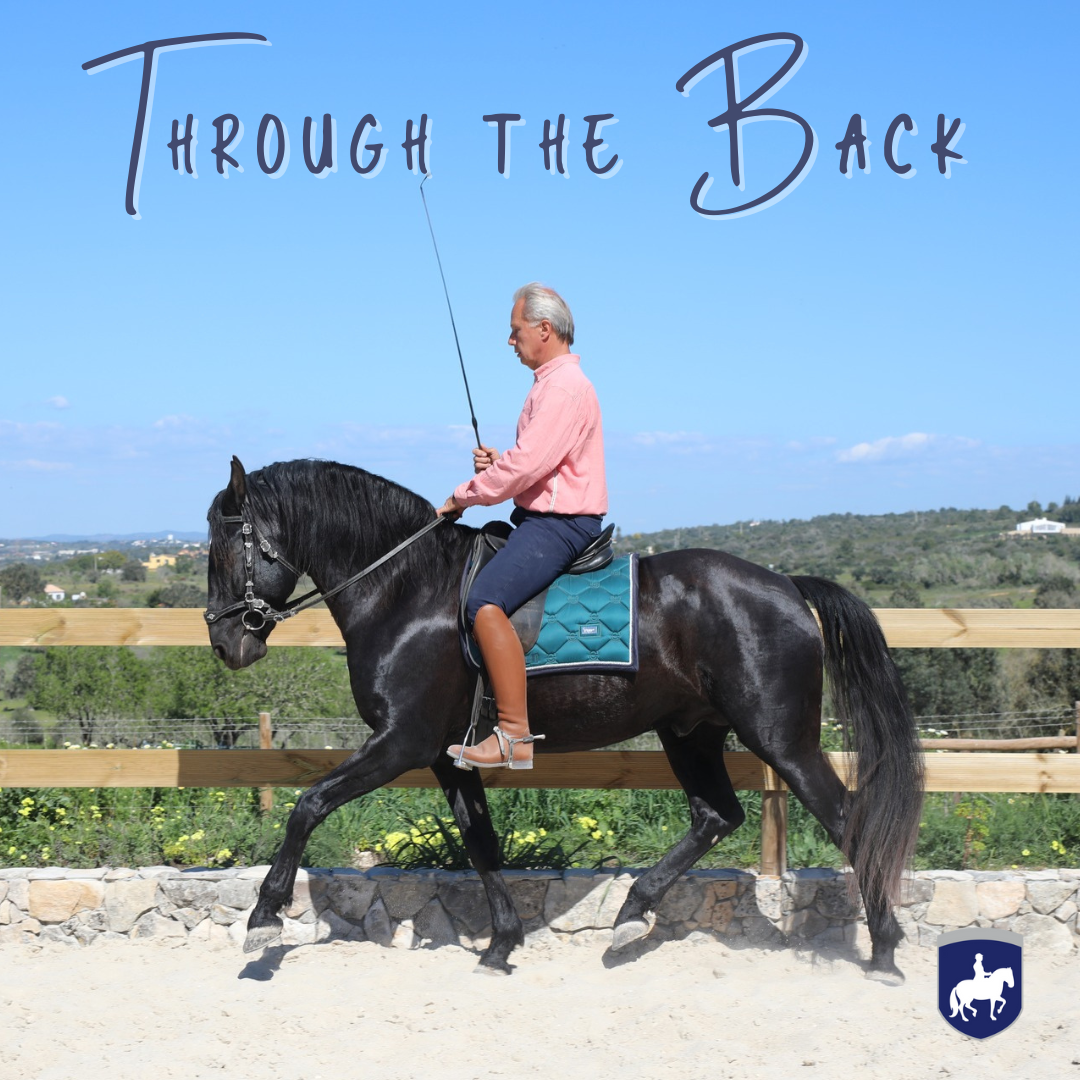
The swinging movement and energy connection that are the result of a horse working properly through the back create a feeling you will never forget. Choose exercises and arena patterns that encourage the horse to engage and flex his hind legs, and remember to use your seat in a dynamic way that supports the horse’s movement, so that he is able to lift his back, engage his hind legs, flex his hind legs, and push off again with them in a forward-upward direction.

You can make the training easier and better understandable for the horse if you try to look at it from the horse’s point of view. Ask yourself what it is you are asking the horse to do in physical, biomechanical terms. Find out which elementary skills your horse needs to possess and which elementary types of movements he has to be able to do in order to perform a certain movement. Then try to build him a ladder of small learning steps that teach him those elementary skills that he is still lacking. Try to utilize the principle of the economy of motion whenever possible, i.e. lead the horse down a path where the movement or transition you want to ride appears to be the most energy conserving thing the horse could do under the circumstances.

What does it mean to ride from the inside leg to the outside rein? And how do I do that?
Inside leg to outside rein is an abbreviation for a relatively complex set of movement patterns that result in a very supple, balanced, straight, and agile horse. The job of the inside leg is to initiate the circle of aids by bringing the inside hind leg closer to the outside one as well as closer to the front legs. This results in a weight shift from the inside shoulder onto the outside pair of legs, which results in an expansion and stretch of the muscles on the outside of the horse’s bend, this in turn creates a contact with the outside rein, which is then able to connect back to the outside hind leg.

There is a general tendency in all living beings to conserve energy, to avoid conflict if possible, and to travel the path of the least resistance. When they move, they try to do so in the most comfortable manner and with the least possible expenditure of strength and energy (they are only human, too).
Water seeks the lowest energy level by flowing downhill, through openings, and around obstacles. Electricity always seeks the path of the least resistance. It’s a natural law that you can observe every day in countless manifestations.

8 habits that will make you a successful rider. If you prioritize the items on this list, you and your horse will progress, slowly but surely. Whenever you feel lost or frustrated, return to this list, check if you have been implementing it or if you have become sloppy with some of these items. If you put one foot in front of the other, you will succeed step by step, even if progress sometimes seems to be painfully slow for all of us.

Energy is not an official part of the training pyramid. It’s not really a formal category of training, although teachers will sometimes ask students to ride a more energetic walk, trot, or canter. I suspect that when teachers tell the students to “ride more forward” they often mean “create more energy”, but the word “forward” tends to lead to more speed, rather than more energy or more power.
The closest thing in the official terminology is Schwung/Impulsion, but it’s not quite the same as energy.

You can communicate so much in a subtle way to the horse at the walk. You can influence better the bend, carriage, size of the circle, and rhythm/tempo if you begin by establishing it at the walk. But not every horse is so keen to walk at the beginning of the work session, I know! They have to learn through gentleness, calm groundedness, and guidance. Once they learn how then it becomes a habit.
Not everything in riding is glamorous. Not everything is special, magical, and brilliant.
Much of the most important work we do, as riders, is work that is simple - even mundane - in its simplicity. But it is where the real treasures lie.
It is one thing to teach a horse a new concept, movement, or skill set. This is important work, too, but at first, it will come with many rough edges. When you introduce it to the horse, you get it in its crude, unpolished form. It is far from “finished” and the real work unfolds from there.